
During the 1940's the Great Valley House was owned by Ralph C. Miller, and Rheba F. Miller. They called it "Rellim", Miller spelled backwards.
Rheba F. Miller, had recorded from an old book, Diamond Rock, which includes a family living on the Swedesford Road homestead during the Paoli Massacre in September 1777. This story by Captain Clifton Lisle has been out of print for many years. Since Rheba F. Miller, had typed the story on onion skin paper, the original copy is very fragile and the typing is blurred. Nancy M. Daily, Rheba's grand daughter. recopied the story "Rellim " -Where the R. C. Millers Live - as written and added an end note.
The Pennsylvania Department of Education categorizes the book as being Historic Fiction.
DIAMOND ROCK, A TALE OF THE PAOLI MASSACRE.
LISLE, CLIFTON. Harcourt, Brace & Co., 1920.
Where the R. C. Millers Lived
Swedesford Road, Paoli, Pennsylvania
"RELLIM" as written in 1945
Paoli, Pennsylvania - the site of the Paoli massacre - one of the battles in the Revolutionary War where Mad Anthony Wayne was defeated by the British on September 20, 1777 after which the American forces went to Valley Forge - is located on the main line of the Pennsylvania Railroad, 20 miles west of Philadelphia.
Its' main street is the Lancaster Pike - the Lincoln Highway running east and west, and two miles to the west and running parallel with it is Swedesford Road where the British were encamped in September, 1777 at Howelltown, (now Howellville) one-half mile east of the Rambo homestead-now the Miller house "Rellim" - which played its part in the Revolution.
The date of the original building of the old part of the Rambo house is unknown.
William Penn received his grant of land from the King of England in 1680 to liquidate a debt of £10,000 pounds which the King owed Penn's father. The land upon which the Rambo house stands was deeded by William Penn to William Mordant, November 24, 1681. A map in the County Seat of Chester County, which was drawn in 1710, shows a house located where the rear room of the present house now stands. Whether this was a log house or part of the present stone house is not known.
The house is of stone - walls eighteen inches thick, and from the fact that all four walls of the back room, now the den, are eighteen inches thick, it shows that this room with the bedroom over it, reached by a ladder, was a complete structure in itself and the first part of the present house. What was the front door - now leading to a hall - is a double door with a sheet of copper plate between the two doors for protection from the Indians, it is claimed. The room contains a "walk-in" fireplace, nine feet wide and five feet high. Walk in and there is seven feet head room in the fireplace. This room was the kitchen and living room combined. In front of the large fireplace where all cooking was done, built into the side wall in a "cantilever" style, is a large flat stone four inches thick, four feet long and thirty inches wide, about thirty inches above the floor, cut out about two inches deep, extending out from the wall which was the sink. A hole through the wall with a wooden stopper let the water out. It is now used as a table in the den. There are only four of these old stone sinks in the old houses in this part of Pennsylvania. Another convenience is a ten by ten room alongside the fireplace opening into the old kitchen built back into the hill which was used as a wood room.

The Great Chester Valley was settled by the Welsh (part Quakers and part Church of England) in the early part of the 18th century. The Great Valley Mill, where grain was ground for Washington's Army was built in 1710 and is a half mile away from the house where we now live and have named "Rellim". There seems no question but that the first house was built sometime in the early part of the 18th century since the land was purchased in 1681. The house was extended sometime before 1777 - what is now the kitchen, dining room and three bedrooms being added. The new part of the house, consisting of the center hall, living room and bedroom, was built in 1791 - as indicated by plate at the eaves. The eighteen inch walls running through the house show definitely that the house was built in three different sections - the last in 1791.
The house is mentioned in a novel, Diamond Rock. authored by Captain Clifton Lisle (now out of print). Diamond Rock is a story of the Paoli Massacre, September 20, 1777, when General Mad Anthony Wayne was surprised by the British and Hessians,' one of the battles of the Revolutionary War just before Washington camped at Valley Forge during the winter of 1777 and 1778. The story covers about the last two weeks of September, 1777 and is built around the thrilling experiences of two boys - each about 14 or 16 years old, both Quakers, but doing their part in the Revolution as did their fathers - one under General Washington and one under General Wayne.
One boy was Joe Lockhart who lived on a farm at "Diamond Rock" - a rock formation containing mica which shines in the sunlight - which was located at the north end of Valley Road on which the old Great Valley Mill (built in 1710) is located and about a mile north of it.
The other boy was Amos Rambo, living with his mother and father on Swedesford Road at what is now our house "Rellim" - the following being direct quotations from the book, Diamond Rock, where so indicated:
'The Rambo farmstead lay on the banks of a large brook at a point where the latter crossed the Swedesford Road about half a mile above the little hamlet of Howelltown (now Howellville). Thence to the Slate Ridge was not more than a forty minute walk across the close cropped pastures and fields of corn stubble, etc."
(The large brook crosses Swedesford Road just at our corner about forty feet from our land and the Rambo farmstead is now our home.)
"...Amos Rambo walked home from the Great Valley Mill, up Valley Road and turned left on Swedesford Road when he saw a large red fox..."
" Amos rushed into the Rambo yard just as his mother came driving out of the barn. (The barn which has since burned was across Swedesford Road from the house - the old foundations are still standing.) For a moment, he feared she would call to him to join her Instead she merely waved her hand asking after the night's sport (coon hunting) saying she was bound for the 'King'." (King of Prussia - a little hamlet which lies about two miles across the Valley from old "Rellim" at Strafford.)
"The Royal Army (British and Hessians) marched east on Swedesford Road past the Rambo farmstead and came to a halt, however, not more than a mile or so below Rambo's house ("Rellim"). Headquarters were established, the officers billeted about the countryside and the soldiers set at work digging light entrenchments near the camp at Howelltown (one-half mile east of our house "Rellim").
"Amos (Rambo) told Joe (Lockhart) of the encampment down the Swedesford Road, just. below the hollow, adding that three British officers were expected at his house ("Rellim") for the night and his mother was too bewildered in consequence to know what she was about."
"When Amos saw his father enter the kitchen (our present kitchen) late that Wednesday afternoon, he knew at a glance that something out of the ordinary had gone wrong. Wisely he pretended to take no notice, merely remarking that the three officers had come up from their encampment and now were having supper by themselves in the living room." (Our present dining room which adjoins the kitchen, the center hall and present living room not being built until 1791-14 years later.)
"Switchen Rambo (the boy's father - while a Quaker was doing scout duty for General Washington) frowned in glum disapproval, then stamped upstairs, his great cowhide boots knocking against the carpet rods as was ever the way with him when put out of sorts. Amos could barely conceal a smile at his father's expense." (The stairs he went up were our back stairs leading from the kitchen - the front stairs in the center hall having been built in 1791.)
"A sudden calling on the part of the officers put an end to his good humor, however. They wanted a bowl of milk and the lad was sent on the run to fetch it for them. When he had returned his father motioned him aside. The man seemed strangely tense. He looked at his son a minute before speaking. Then he began in a very low voice, growing more quiet and calm as he went on - 'Amos, thee's a Friend, a Quaker, I take it, like thee mother and I. Still thee has a country to think of, too. Thee owes somewhat to her. Listen, my boy, is thee willing to help thee native land in such a way as thee can without bearing arms? Thee's a bit too young for that just yet. Will thee say thee's ready to play the man, none the less?' Rambo paused, then concluded with greater earnestness - 'Think well before thee speaks, son. I may have put it too strongly. Mother and I have reared thee to be a peace-abiding lad and walk in quiet ways. Follow the spirit whither it guides thee and thee can't go far from the right.'"
"In a few words, he had explained what he wanted, keeping his eye all the while upon the living room door."
'"I'm going down to Havord's place by the Forge bridge right away' (old Valley Forge where supplies for Washington's army were hidden). 'There's work to be done this night. They'll not miss me here, either, I'll trow.' He nodded towards the living room (our present dining room) door whence came the sound of merrymaking. The officers were still lingering at supper. Rambo continued - 'Thee's to bide here till nine, then get out of the house without anyone hearing thee. Meet me at Havord's gatepost with the Chestnut (horse) half hour later. Keep clear ofHowelltown (the British camp one-half mile east) whatever thee does!'"
'"If thee meets with any of their sentries, just act as if thee was going about thee own affairs. Tell them thee's bound for Cousin Potts for the night, because they've left small room for you at home with all their billeting.'"
"By nine o'clock, the Rambo household had settled down for the night, at least, in so far as there seemed to be any immediate prospect of its settling, for the officers were bent upon a night of it at cards."
".. .After spending the night moving stores and equipment at Valley Forge, Amos returned home before daybreak..."
"As he approached the farmhouse ("Rellim") on the Swedesford Road, Amos redoubled his caution, creeping all around it before venturing in. A light glowed faintly in the living room (our dining room) window downstairs. Clearly the three officers were still at their cards, though drawn blinds prevented him from seeing them. Cautiously he worked his way to the back door, very quietly he lifted the latch and entered. Slipping off the heavy boots that would have betrayed him, Amos crept on tiptoe across the kitchen flags dreading the collision with chair or table that could not fail to give away his whereabouts. A thin shaft of light from the keyhole of the further room (our dining room) served to give him his bearings, that and the subdued murmur of voices beyond the fast closed door. Bending his ear to the tiny opening, he listened, catching a word or so of conversation now and then. Suddenly another, a clearer voice than heretofore, began to speak. Amos held his breath as he sought to catch the words:
"Ah, yes - quite sure of it. Quite! Washington's not such a fool - of course. I know the place - a little spinney - a surprise - The Paoli - Grey's the man for the job (General Grey in charge of British and Hessians). Grey and cold steel (bayonets). 'I say, Haverly,' the tone changed as a new speaker broke in, 'I say, how the deuce do you always find everything out? Still playing your old land survey scheme? Now, if I were to ...' the sound died down to a confused mumble once more."
"Amos had heard enough, however, to whet his curiosity. This was no idle game of cards. Some sort of conference was going on behind that closed door. Again the boy bent low to listen. Just as his ear touched the knob, the sound of approaching footsteps warned him to retreat. It was too late. The latch clicked suddenly and the door swung wide, before the startled lad could move a step from his betraying posture. A man stood before him in the gleam of a lighted candle, held high above his head. An empty water pitcher explained his mission."
"Even as the jug crashed to the floor in fragments, Amos knew he was trapped and branded beyond recall as an eavesdropper. He saw the officers about the table spring up. He felt the sudden stab of wounded flesh in his arm (he had been cut in the arm while at Valley Forge) as they dragged him roughly forward to the light."
"He bit back the cry of pain that rose instinctively to his lips, yet all the while his eyes were upon the man that held the light. It was none other than the stranger in riding clothes he had met with earlier in the evening - the man who must have tracked him from the stable all the way to Havord's gate and brought the hostile troopers on the gallop to the barn where lay the stores. Haverly, the spy from town (Philadelphia) had transferred his operations to the Valley."
"On Saturday night the 20th of September, 1777, where the enemy lay behind their entrenchments at Howelltown an unusual stir seemed to have upset the well ordered routine of the evening. The vigilance of sentries and outposts had grown suddenly more strict. Quaker farmers passing up and down the Swedesford Road on peaceful business of their own were politely, yet firmly, told they could go no farther. All approach to the camp was barred to men not in uniform."
"At Headquarters, a round table conference had been called immediately after supper. The Earl ofCronwallis held the chair. 'Gentlemen, you are to strike at midnight, precisely all of you together. You will have three thousand men, the best in all England, the King's own household troops. With a few hundred surprised yokels hemmed in on ? every side, there can be no resistance to our superior forces. They are but a handful of ill-armed farmers at best - peasants in rebellion, above all, get that arch-rebel Wayne!" (Mad Anthony Wayne)
"Since Wednesday night, after having been discovered as an eavesdropper in the kitchen, Amos Rambo had been a prisoner in his own house ("Rellim") nursing his wounded arm' and chafing bitterly against the restraint, surprised by the hostile officers (who were in the dining room) as he stood listening at the door, the boy had been identified by Haverly (a Tory Quaker living in Philadelphia who wore a colonial uniform at times as a spy for the British) as having had something to do with the hidden stores (at Valley Forge). Nothing more appearing against him, however, they had decided it would be sufficient punishment to keep him under lock and key for the time being, as they well knew their best chances of success in this war lay in winning over the people who were not yet in open arms against them."
"For three whole days, Amos paced his garret like a caged beast." (The garret was the third floor attic over the living room - now the dining room and over the southeast second floor bedroom which garret is now the third floor bedroom and bath.)
"At nightfall, Amos pushed aside his half eaten supper and flung himself despondently on the bed. He could not even sleep to while away the time that dragged so slowly onward into darker night. The wound in his arm was sore, the smart and throbbing of it causing the lad to toss in restless fever from side to side."
"Just as he was on the point of dropping off to sleep at last, a curious sound began to come in through the tiny window beneath the eaves. With a low, dull rhythm it beat upon his ears, lulling him, soothing him into oblivion. The steady tramp of marching feet, many hundreds of them, keeping step together, up the Swedesford Road they came, not a light to betray them, just the pulse of footfalls and the faint rattle of kits and accoutrements in the darkness." (Swedesford Road being about sixty feet from the house and between the house and the barn which was across the road.)
"Suddenly Amos sat up, wide awake and tense, his wounded arm forgotten, his brain grasping at the sound it had heard. Again he caught it - the shrill, quick whir of an officer's whistle. Once more the rhythm of marching feet. That was all, but the boy had heard enough. Noiselessly he slipped the bareshod from the bed, hurrying to the window. Without the night was full of shifting light and shade, now clear, as the moon rode free among the cloud rock - again overcast and murky."
"Amos peered down toward the road where it crossed the bridge in the hollow, just at the foot of the yard. (The attic window is in the east wall of the house, just under the roof, third floor - now the third floor bedroom window of "Rellim". The brook crosses Swedesford Road at the east end of the lot - there is a stone bridge there now.) The light shone fairly upon it for the passing moments. The boy gazed spellbound as he took in the scene below. A company of stalwart Highlanders were crossing at that instant, tartan kilts swinging, bayonets gleaming like molten wands in the moonlight. Other regiments followed. The column seemed endless as it swung by, four abreast, the officers walking their chargers silently along the turf of the road side. Then at last the boy saw meaning in the words he had overheard. This was their surprise. The Americans were camped in a wood near Paoli. The lad turned from the window, his hands shaking with excitement as he felt about for his clothes. He would make on effort, at least, to warn his fellow countrymen. It seemed a forlorn hope, but the boy had spirit and grit enough to fling himself whole heartedly into the attempt."
"Amos had his hand upon the door knob before he remembered that he was still locked in. The realization of his helplessness came as a shock. Crossing once more to the window he searched the road below. It was deserted. The last company had passed on to the west. If he were to accomplish anything before it be too late, now was the time to act. The boy leaned far out of the window, scanning the side of the wall of possibilities of escape. Fortunately the house was old, the stone work thick with ivy. It was a chance whether the vine would bear him, but Amos gave scant thought to that."
"Feet first, he pushed and squeezed his body awkwardly through the narrow opening of the casement. An inch or two at a time, he lowered himself down the wall, here a handful of vine giving way beneath his clutch, now a thicker stouter stock holding firm against his weight. He had proceeded in this fashion about halfway to the ground, when a particularly rotten patch of the ivy caused him to stop, clinging in silent fear to a window ledge." (This window was in a small second floor bedroom - now one of the second floor bathrooms at "Rellim".)
"He turned his head about in an attempt to see how much of a drop remained beneath him. The next instant he had shrunk close to the wall digging his fingers into the stone work till they were torn and bleeding from the effort. A red coated sentry had appeared at the corner of the house, slowly pacing toward him."
"For a moment, Amos feared his grip would break, the strain proved too heavy for his strength. The wound in his arm began to bleed afresh, throbbing and stabbing painfully beneath its bandage. Just as he knew the end had come and he could cling no longer, he heard the footfalls turn the far corner. A quick glance downward reassured him the way was clear for the moment, at least. The sentry had passed on. The boy clinched his teeth, drew a quick breath, then let go the ledge and dropped into space. There was no time for' crawling now. The fall was not more than ten to twelve feet, but Amos was heavy and struck the ground with considerable force. In spite of the sudden shock, he kept his head, however, rolling quickly into the shadow of a cellar window whose wooden bent was fastened back against the wall."
"Scarcely had he reached it, when the sentry again appeared. Amos bit back the groan that his wounded arm forced upon him, smothering a sob, as he lay face downward in the grass. (I can show you the grass, it is still there.) Then he held his breath as the man passed by. It seemed an eternity before he dared raise his head. Assured the sentry had gone from view, he drew himself painfully to his knees, gave one searching glance about the yard, then, springing up, raced for the shelter of the orchard." (A few of the old orchard trees are still standing - perhaps not the same ones.)
"As often happens, however, the best laid schemes must be changed at the last moment. Amos' first intention had been to slip from the cover of the trees to the rear lane and thence up the hollow of Valley Creek to the Great Valley Mill. The appearance of two more sentries chatting together by the barnyard gate caused him to pause and reconsider. The presence of so many soldiers puzzled him. Could he but have known it every homestead on the Swedesford Road from Howelltown to Valley store was under similar watch and guard that night. Amos drew nearer, dodging from tree to tree, expediency urging him to find out, if he could, what the men were saying. He was well repaid for his effort."
"Amos had heard quite enough. He knew now the purpose of the expedition, and the location ofWayne's encampment. The Red Coats were already two miles in the lead. If he were to reach Wayne in time to do any good there was but one way, to ride, to ride hard and fast. Backward he glided, still in the shadow of the old fruit trees; quickly he ran to the rear of the barn, dreading each moment the cry of his kenneled hounds that would ruin all. The sentries continued to chat by the gate, laughing occasionally in low tones."
"Amos crept down the passage way between the stalls, going carefully and on tiptoe. The little roan whickered softly as he felt for her head in the gloom. Finally with saddle and bridle on, the boy turned to see if the road was clear. One sentry was at the stable door pacing slowly in the moonlight. The other sentry stood before the barnyard gate, rifle hung comfortably in the hollow of his arm. The lad was as much of a prisoner as when confined in his room. He had to get away - was not Wayne himself in danger? His own father might be with him. All the valley men fought under Mad Anthony if they could." (Anthony Wayne was born and reared in the Great Valley about two miles from Paoli. The house where he was bom is still standing and one of his descendents lives there at the present time.)
"Grabbing a huge stiff bristled mane brush he took careful aim and flung it in a great arc and with a crash it struck against the kennel door. The next moment pandemonium had broken loose upon the night, as the startled dogs rushed out into their little yard. The more the sentry shouted to quiet them, the louder rose their roar. The sentries rushed to the kennel, beating with their musket stocks against the fence. Amos pulled the mare across the door, swung to the saddle, sent both heels home to her sides - the mare leaped high and was gone down the road."
Amos did not reach Mad Anthony Wayne in time. He was captured by the British who had already reached the camp. Wayne had fourteen hundred men. The British surprised them while sleeping with three thousand men. No shots were fired - only bayonets used. Three hundred Americans were killed and eleven hundred escaped with Mad Anthony Wayne and joined Washington later at Valley Forge. This battle is known as the Paoli Massacre.
"Amos described to Joe with close detail the strange and uncouth Hessians he had seen at his father's house ("Rellim"). 'Will thee credit me, Joe, there was one of them came to sit at meat with us last First Day (the day after the battle) that is not with us, but with the three officers they'd put upon us for billets. He was a great brawny man and when my mother set the loaf before him, he broke off a huge hunk with his fist and smeared the butter all upon it with his thumb nail. 'Twas more like a savage in the backwoods, I tell thee, than an officer from a Christian land. On Tuesday they broke camp at Howelltown and moved toward Philadelphia.'"
And thus endeth the part played by "Rellim" our new home, in the Revolutionary War -at least, so the novel by Captain Clifton Lisle sayeth.
Compiled by Rheba Frame Miller for her family in 1945 -
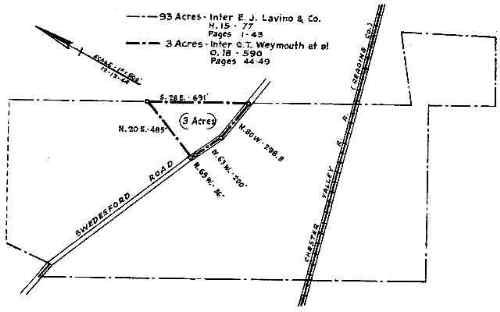
End note: Ralph C. Miller, Sr. and his wife, Rheba (Rebecca Esther) Frame Miller moved to their Swedesford Road home located in Paoli, Pennsylvania on November 28, 1944. They named their estate "Rellim" for two reasons; "Rellim" was Miller spelled backwards and this was Rheba's "Realm". Rheba so loved her historic 4.5 acre homestead that she spent a great deal of time researching its history.
Since the land was deeded to William Mordant by William Penn in 1681, it is believed that this historic homestead was originally built sometime in the late 1600's or early 1700's. The house has been dated to 1710, since this is the first documented record from the County Seat of Chester County which shows on a map that a house is located where the present home now stands on Swedesford Road.
As indicated in the book Diamond Rock, by Captain Clifton Lisle, the story of the Paoli Massacre mentions the Rambo farmstead on Swedesford Road during the later part of September 1777. Not having any proof from historical documentation, we will assume that Captain Lisle was probably accurate when he associated the Rambo family as living in this home during 1777 when he authored his story years later. It is through this same story that we learn that the Rambo family, who were Quakers, supported General George Washington and General Anthony Wayne to gain freedom for their country from the British. Based on historical events, it is probably true that their home was not used by Washington or his troops, but instead it was occupied by British and Hessian soldiers during the days leading up to the Paoli Massacre on September 20, 1777.
Due to the unforeseen death of her husband, who died on his birthday in December of 1945, Rheba only occupied her beloved home for another four years and sold "Rellim" in September of 1949. It is through this wonderful woman that we have acquired such a rich history of our family and have inherited comprehensive records of our family's genealogy.
With deepest gratitude, Nancy Miller Daily - April 2004
